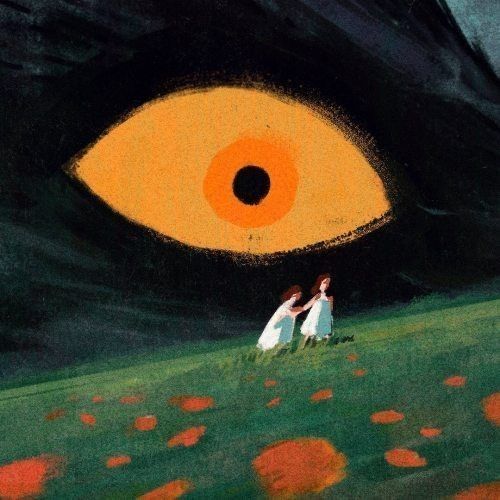
click here to check out the artist from the cover.
I discovered Stromae’s music about a decade ago. A YouTuber I used to watch recommended his 2015 live show for racine carrée — his last album at the time, released in 2013 — which is free to watch on YouTube. I fell in love with that Belgian kid. I remember the show having these very simple ideas that were so interesting, but they only worked because of how charismatic, creative and energetic Stromae was on that stage. He’d do crowd work, asking the audience to say certain words at certain moments and even dance in a specific way while being humorous, all while his traditional Electropop/House taste was being spilled. His electricity was, perhaps, very magnetic, and the existence of Pop songs with deep political or social messages is always attractive.
The years would pass by. It must’ve been 2018. Somewhere before December, as my mother was still around.
I was listening to his music video for the song quand c’est, also from racine carrée. The song talks about cancer (a word that sounds like “quand c’est”), viewing it as this thing that creeps up and can show up at any time and ruin someone’s life; the song even compares cancer to a serial rapist in the language used. The music video was simple, just Stromae slowly dancing and moving in a black and white space, evading from cancer’s “spider legs” until it’s too late.
My mom had metastasis at this point, and unbeknownst to me, she would die at the end of the year. For some reason, I felt like showing this video to her.
Cancer was a weird subject to me at this time. My mother would never speak too much about her condition and the technicalities of her trips to the hospital to me. She would eventually say that I was too young to know and worry about any of that.
I was not that young, but I also think there was a sort of relief of hers on not speaking about it with me. When we were together, we’d mostly sleep in the same bed during the evening, talk about school or something unimportant; we’d spend our time as if we had all the time in the world with each other. I was her getaway from this life, in a way.
But this was not the best decision, in many ways. Even though I had an idea of her condition (it was impossible not to know when it was really bad, with her convulsions and medications piling up), I would only know that she was a mortal being a day before she passed away. Before that, she was the strongest woman ever, she would always live. She had to. I wouldn’t even think that any conversation we had could be our last. And then, at her funeral, I just screamed and cried as I did the entire day before, when we got the notice. The shock of her death ended up causing some weird reaction in my brain, which either developed my OCD or made it severely worse. As the Caetano song says, she never taught me how to forget her.
She would always say to me almost word-for-word the main motif on My Chemical Romance’s 2006 song Cancer, without ever having listened to the song: The hardest part of this is leaving you. She’d say this to all my siblings, too, but when we were alone, she’d say that I was the one she was most worried about leaving behind. Not because she loved me more; she’d never say such a thing. She’d say I was too young, that I didn’t know how to live in this world yet. I was too shy, too wimpy, too sensible, I needed her too much. She could feel that I wasn’t ready for her absence, that I would react poorly to it, and that she hadn’t finished teaching me anything about the real world, knowing I was an even bigger recluse back then.
So, now and then, she would ask me what I’d do if she died. I’d say something silly as if I was 5 years old, like “you are going to live to 200 years old!!!” When she knew I didn’t know what I’d do, she would talk to me briefly about death.
I don’t remember how she reacted to Stromae’s music video as I don’t remember what she said to me in any of those conversations about death, about her departure. My depression took care of my memories a long time ago, and I have these big spaces in my brain filled with nothing but feelings, sensations of a weak presence no longer there.
But I remember when I showed her Papaoutai, another song in racine carrée and its most well-known song. In it Stromae describes the absence of his father in his life, a man who before getting killed in the 1994 Rwandan genocide was already a ghost in his life.
I don’t like to talk about my father a lot. Every time I change psychologists, they always end up wanting to know about my father after I mention my mother so much, but I always say I don’t feel interested in talking about it. I don’t feel I’m hiding something; he’s always just been unimportant to me.
I can never say he was absent, even though he is, because his presence in my life upset me terribly. When he’d be home, he would occupy an entire room, usually the living room, turn up the TV very loud, sit on the floor and eat with his mouth open some disgusting thing someone else cooked for him.
And this was his peaceful mood, as every day, he’d inevitably have a fight with my mother, upsetting everyone in the house. They’d just scream, break a door or even a television once, and the subject was always cheating. My mom caught my father cheating around the time I was born, which led to fights that were so bad we had to move from the house my grandmother worked her entire life to build because of the neighbors and local thugs getting involved.
Before she died, she said she had to forgive him, as she was trying to come to terms with her Christian values and her death. Before that, she caught him cheating again, which must’ve been the millionth time after that first one, and one of the millionth times he cheated on her while she was under cancer treatment. He denied that he was cheating this time, and even my grandmother, one of the people my mom loved the most, would fight with my mother to defend her son. When my mom died, my father quickly married that woman he cheated my mom with, and they both now pose as Church people and a couple in peace with God after making the life of a woman with cancer a living hell.
However, her reaction to the song Papaoutai, the song about an absentee father I showed her and told her “Hey, mom, this is how I feel”, was totally unexpected. Or at least unexpected for someone like me, young and dumb, not a complex person at all.
She cried, cried very hard. She would feel so broken, she’d start to say things I never heard her say before and after. She said that all she wanted was for us to be a family, she always wanted to have a happy family. That’s why she never left my father, but then she told me that she would blame herself for that. She’d blame herself for giving us this father. I probably never saw her cry so much, I felt so bad for causing it. I never knew that was how she felt.
I would end up learning to live with my father’s existence after she asked us to forgive him before she died. Today, he does not live with us anymore, but when we have some mail to receive, we send it there and he brings it to us, since receiving mail in the favela is quite hard. We talk normally, joke, discuss the future… He’s still not a father, but his presence doesn’t bother me when in small quantities.
I suppose these are the thoughts that come to me when I listened to Papaoutai.
Some songs I listened to from this time seem to carry this feeling as if the winds of change weren’t supposed to be this strong. As if I didn’t have to learn to be an adult in a year, but that was how it had to go. I even remember one of the last songs I listened to before knowing about her passing, “Roda-viva” by Chico Buarque; this foretold change would just be too much.
But now, listening to racine carrée is like thinking of a deceased person; the bad times only show up if you force your memory quite hard. The things in evidence, most of the time, are the good times. Racine carrée has this energy that makes you want to live and dance, beyond life, but in it, like the electricity of the human body channeling a mass reaction, making everyone happy for being under the rain.
Now, I don’t wish to overextend our time talking about every song, but I think it’s necessary for the understanding of the whole album that we talk about its first song.
Ta fête to me always sounded like the logical next step from “Alors on danse”, Stromae’s breakthrough single from his 2010 debut album Cheese, so I was glad to research about it and discover that it is, in fact, its spiritual successor. Not only is it the song in this album that is most similar in terms of its melody and structure, but here we also have similar themes: everyone’s trying to bother us, so we dance. The problems of life, the trouble we get into… Let’s just dance.
I think this is the best song that could’ve started the album; I even think it was made precisely for that purpose. We say goodbye to Alors on danse, although it does come back in the Montreal live show for the album, and we immediately introduce how things are going to work out for the rest of the album.
Now, I’m not as well-versed in 2010’s Cheese, but it is quite clear when listening to the songs in racine carrée that Stromae’s main characteristic as a songwriter is his ability to identify different meanings you can attribute while using the same words — and in no other song in this album it’s as apparent as in its opener. In his verses and chorus, he’s constantly singing a word just to turn it around in the next phrase. Even the title of the song is supposed to pull this trick, using the different meanings of the word “ta fête”.
It’s time
The time for dancing is over
Dance on
Don’t worry, you’ll be dancing
Swing on,
Before they take a swing at you
Drink up,
But you’re gonna get wasted
You just want
To party (ta fête)
Your mother meanwhile
Is on your case (ta fête)
The judge too
Is on your case (ta fête)
Everyone has got it
In for you (ta fête)
This little trick is everywhere in this album. In the chorus of one of this album’s highlights Formidable (You were wonderful/I was so pathetic), for example, he displays this ability with a homophony (Tu étais formidable/J’étais fort minable), as well as in the previously mentioned quand c’est. Starting off his album this way, Stromae is developing his taste in his preferred language (not French, but his language as a songwriter) as he is setting the stage for the next moments.
Tous les mêmes, the other big hit from the album, talks about “a relationship and how a man and a woman can be so ridiculous”, according to the man himself. It’s about this couple having a fight, but mostly from the woman’s perspective. I loved the music video for this one at the time as well, and here Stromae, as in songs like moules frites or bâtard, tries to shove in society’s face its own problems, its own incomprehensible ignorance and pettiness, all while making you dance them away.
I do think that, with the abilities he had at the time, this was the best album he could come up with, which is a nearly impossible thing to say about any band or artist. I don’t think the album is perfect, but it is tremendously effective. Ave cesaria, carmen… For an electronic album in the 2010’s, it surprisingly still holds up to this day, which is sad to note that the issues discussed are also necessary to listen to currently.
It is not bittersweet — quite the contrary. It’s sweet to live, be able to still be happy near my family and the world which has not abandoned me yet. This is the gift my mother gave me and the one that now has a different taste as she does not live in this house anymore.
The more you do the exercise of memory, the more things start to become a bit clearer, and once things are clearer, they are not as pretty. I suppose in life there is a flower we’re not supposed to let wither, even beyond where our hands can carry. As a flame that we pass on to burn forever, that was passed to us from an existence before eternity. And this moves us as our fuel, it shapes the world and the body and soul; it is as water as a river could be just a hole in the ground.
To me, Stromae’s racine carrée reminds me of it. It successfully makes me want to move (or rather, dance) so that the world can be painted in my colors, as we are all struggling to get out of the shadows of the ones who painted the world before us. And if life is a stage and each must play a part, I choose to dance.
About the text: After reading about Mitski’s take on long term relationships and marriage while I was writing about her song Me and My Husband for last month’s playlist post, I decided I should probably end my Stromae text which was brewing since the beginning of January. I started to think about my now deceased short movie about a couple fighting and had to come to terms that, at least subconsciously, it was about my parents all along. “What makes this couple still be together after all their fights?”, I asked. Well, in my mother’s case, it was us. With families like this, the children are always “at fault”.
But no. I remember that it wasn’t all just fights. She’d make up with him sometimes, at least once a year, and they’d be in good terms, kisses and all, until the next fight inevitably happened. Even though we were still there, she still wanted to love and be loved by someone. I suppose I see myself in her when I feel this space in our hearts; she’d be able to live with my father’s mistakes as she always wanted to have a husband, father of her children. Remembering this made me remember what she told me when I showed her Papaoutai, and thus it felt necessary to finish the text.
As I said, until I can finish all the January texts I half-wrote back then, I don’t think there’s a lot of time to write in Portuguese. But I thank my brazilian friends for the patience. On another note, I will be testing out a SEO designed title for this post in WordPress. I think they’re really fucking shitty, so it’s just to test. If you wish to know the actual title, check the Substack post (shameless plug).
You won’t have this life forever. Even in my darkness, I wish I can love and be loved continuously. And if I do not love or cease to be loved, I wish I have the strength to let go of the hand, as I let go of the hands of my family before I die. I simply do not want to repeat my mother’s steps in this matter, even though love is the trickiest thing. I, too, still have clothes wet from the oldest of rains.
Listen to Nightporter’s February playlist below.
the-thief is a reader-supported publication. To receive new posts, consider becoming a free subscriber — It helps the morale! To support my work, consider becoming a paid subscriber or buying me a coffee on Ko-fi!

![[en] updates on the front page!!!](https://the-thief.blog/wp-content/uploads/2026/03/image-14.png?w=603)
![[en] Nightporter’s Playlist for February 2026 (beautiful edition)](https://the-thief.blog/wp-content/uploads/2026/03/image-13.png?w=1024)
![[br] Eu Acredito em Mágica](https://the-thief.blog/wp-content/uploads/2026/03/b642d15566f93254881327a8d1a2f2ac.jpg?w=771)
 the thief
Deixe um comentário