What is the immediate way of expression? What comes first: your look of disapproval or your harsh words? Which one connects first, which one is received and apprehended the fastest, which one dilutes easiest in the water past our wailing?
While reading Sontag’s book “On Photography”, she constantly talks about the way that certain forms of art fight about which one better represents reality, or even, which one is better as a form of expression. Could it be the paintings? Or maybe poetry? Photography, soon enough, was arising to be a direct form in which the perceiver seemed to be the most connected with his self in the shape of reality and, also soon enough, discussing if it even is art at all.
To me, it’s entirely too complicated, as it must’ve been for her to write about it. I am interested, however, in language. Language to me is the breath of the expression, if not the body. Every shape art takes has a language; not only the inherent technicalities and rules in which art can be bent or straightened (the 180-degree rule in cinema, for example, or the numerous architectural rules for any built space), but also the language of the artist. As a kid may create a fake language to communicate with their siblings, every person speaks in a language of their own, and it is the primary language in which any art they make is spoken in. It goes beyond the point of view of an artist’s intention or the meaning of a piece; it is the air inside every breath contained in every empty or occupied space, the exact steps and stillness required for their expression.
Language, as I hope it’s clear, is a thing that doesn’t need anything to be written. There’s language in photography, in paintings. The expression in which the artist not only is the sole interpreter, but they can also be completely oblivious to what it means. “Why did that painter choose blue for that spot?” There’s a chance, even if small, that they don’t even know. But it is not meaningless. It just so happens their language is so deep, it is hidden from them, sometimes. The way they communicate with themselves and with the world is so cryptic that they sometimes don’t have an answer to their questions. In a way, there is no randomness in an artist’s language in this way, as their infinite taste is home for every accident and intent. “I randomly chose to grab a brush with the color yellow and splash it in the canvas”, they would say. Not meaningless, still.
I believe in this, as I see it happening to me. I must’ve told this story once — or not, given it’s from an unreleased song. But once I wrote a phrase in the chorus of a tune that was so cryptic, I had no idea what it meant a few days after I wrote. It took me some months, and then the feeling I was talking about in that phrase happened again, and I immediately connected with that damned phrase and remembered it.
If language can be so intimate, so deep within you is the way that you express yourself, then I think art, regardless of its shape or relation to reality, is an attempt to decipher the language in which we truly speak. The language in which we dream. And if we’re dreaming of another person, and if we combine the languages in which two people speak, we create the most intimate of moments a human can participate in; if sex is when the bodies get so tangled they melt into each other, when the languages are combined the soul gets thrown in the mix.
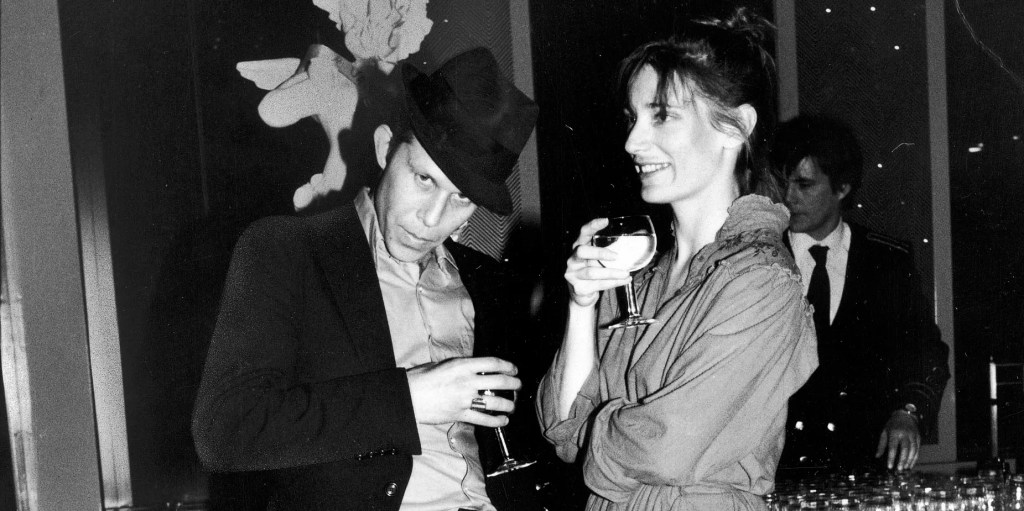
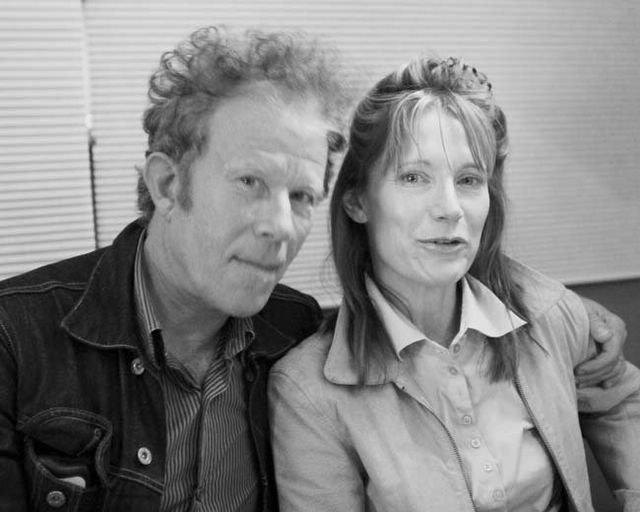
Kathleen Brennan is Tom Waits’s wife. The story goes that they met each other when he was doing music for Coppola’s “One from the Heart”, she was editing the script of the movie at the time. I must say, it is curious to try and fit them together once you’ve seen a photo of them. She looked so modest, with her wit emanating from her as a bright light, so clean. Back then, he looked and sounded like he was trying to make his best impression of a drunk tramp. But they got together, and soon enough she started to seep into his life.
He wouldn’t smoke, at least not in front of her. And no more nights at the motels sleeping poorly through the midnight haze. But what interests us the most today is how she entered his artistic life. For you to understand her impact on his persona, you’ll have to know who he was.
The “drunk on the moon” guy, Tom Waits. He’d write mostly straightforward songs about being in the bar or drinking or walking through the night alone with a cigar and no wit left at all. He was known for his piano ballads. He always had his characters and his towns and his misery; those were always there. But if he was by his design, he’d probably stay in this lane until an early grave caught him.
TOM WAITS: “I fall into a groove too easily. I get in there and say, ‘Oh, here’s my place.’ It’s like a shovel handle. Even on the piano, my hands are at the same place every time, because your hands have an intelligence that’s separate from your own. But sometimes you need somebody to say, ‘No, put ‘em over here and try this,’ and she does that. She calls me on all that stuff. ‘Oh, this again, oh Jesus! Oh, here’s the hundredth one of those.’”
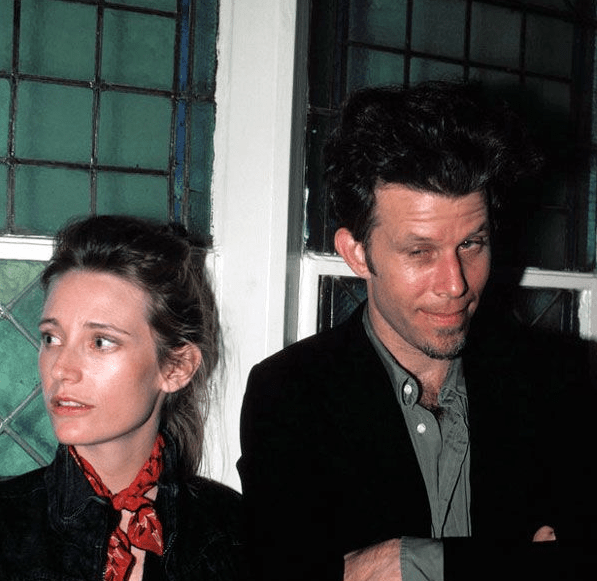
She introduced him to various avant-garde artists and “encouraged a more radical approach to songwriting”. She influenced him as early as Heartattack and Vine (1980), but it was on his 1983 record Swordfishtrombones their union started to really flourish. The first of its kind, Swordfishtrombones introduced a completely new Waits. Reckless, smoothly sinister, crazy as never before, while still edging around his sensitive side like a drunk flower.
From then on, Waits started to be known mostly by this side of him. Rain Dogs, Bone Machine, Mule Variations. More and more, through the many phases in his career, he solidified his language in a way even he thought it was not possible. All of these posterior records have something in common, however. Most, if not all, were co-written with Kathleen Brennan. Not only did she reinvent his sonic style, but she would also partake in the lyrics. Her name would often come before his name — a decision made by him. She’d arrange and produce all of the tracks and even participate in the writing for his 1988 live performance movie Big Time.
BK: What does Kathleen contribute to the writing process?
TW: We collaborate. Who knows how it really works, if it works? You know, you wash, I’ll dry. She stays out of the limelight. That’s what she prefers. I’m out there, I’m more song and dance, and she’s more behind-the-scenes. She prefers it there.
BK: In retrospect it looks like she’s added depth and textures to your albums that weren’t there before.
TW: Well, you’re married. You know how it is. She’s the brains behind Pa [laughs].
BK: Do you ever listen to your old things and think “That’s not very good”?
TW: Yeah, I do. I can’t listen to the old stuff. I’ve got big ears and I dressed funny. And I have a monochromatic vocal style. I have a hard time listening to my old records, the stuff before my wife.
As the language of any tribe, the language as the expression of oneself is always evolving. Soon, you look back on what you wrote and see no meaning at all to where meaning was everywhere. But it is beyond meaning, it is as if the transitory space from which your soul passed by many years ago is unrecognizable. Now, Waits passed through this realization after meeting the love of his life, with which he’s still together to this day. Their languages became so intertwined, he can’t even recognize the language he used to express himself before he met her. She gave Real Gone, one of my favorite albums from Waits, its name, and Black Market Baby, one of my favorite songs from Waits, most of its lyrics.
TOM WAITS (About his writing process during Mule Variations): “You texture and layer them and turn the lights down inside the song…after a while, you do it by taking things away, and adding things, until you have just the right feeling for where you’re going. It’s like a room in your ears. It’s like throwing a T-shirt over the lamp by the bedside to change the way the motel looks. Kathleen came home with “Black Market Baby.” She had it almost all finished. She says, ‘She’s my black market baby, she’s my black market baby, she’s a diamond that wants to stay coal.’ I thought she said cold. That was almost finished the minute that she said that. Just kind of filled it in.”
And the more you listen to Waits describe his writing process with Brennan, the more it looks integral to the shape of his married life. His art and his language turn to be true of his movements and mannerisms, as if the tasks of which he’s obliged to do all pass by her heart on the way to work.
JV: So how does it work with you and Kathleen writing songs together?
TW: We just throw out lines, it’s like dreaming out loud. When we’re writing, we kinda go into a trance.
JV: Kathleen goes into the studio with you, right?
TW: Oh, yeah. She and I produced the record. It’s like she’s tying a rope around my waist and lowering me down into the well, hollering “A little more to the left, a little more to the left.”
The language between two people in love; that is something that can be documented. And I’m sure Waits has brought a lot of his love for her on his lyrics — I can’t imagine All the World is Green is completely absent from words for Kathleen here and there (or even words for Waits, as she co-wrote it, too). But the most important aspect of this view on language is that of the collaborative effort of the best possible translator for your soul: your partner.
AP: It seems like that’s the same case with making records. How different do you think your music would be if you hadn’t married Kathleen Brennan?
TW: It’s so hard to say. Everything would be different. She’s a remarkable collaborator and we have a real rapport, and that’s really what anybody who is working with anybody else is looking for. It clicks.
AP: I’m interested in the way songwriting works in your home. Less the artistic process, more the physical one—do you and Kathleen write in the same room, do you snack, do you bicker?
TW: Sometimes we go in the car, just take the tape recorder and go on a long trip. Sometimes we just sit around the piano—if we have a deadline, it tightens up the perimeters of the whole thing. We work independently and we work together. If both of you know the same stuff, one of you is unnecessary. Hopefully we’re coming at it from different angles. But I don’t really know how it works. It’s one of those things where you can’t really take it apart.
Your partner in crime for your artistic efforts. When your language is too tangled in your unconscious mind, you have someone there to translate it. But beyond translation, it is the assimilation of both languages that turn into a single one, completely homogenous. Waits didn’t suddenly started to write better, he was always a very skilled songwriter. But Kathleen brought him the true essence of what he was trying to say by bringing what she wanted to hear; bits of her language started to join in his until they were saying the same thing.
If language is supposed to be the body of the expression of a soul, this is the most beautiful representation of the unity of two people. When two people speak the same language, after so many years of marriage, they unlock the understanding of the separation — rather than detachment — of their own selves. And if the artist’s taste is infinite, their union with someone who truly understands them manages to surpass the countless number. Beyond a muse is a collaborator, sharing the interests of the artists as they’re an artist themselves, creating a language that is not about its cryptic nature, as many artistic languages (such as mine) are, but about how much is shared by the mere presence of a conjoined heart.
BM: Your wife, Kathleen Brennan, was heavily involved in Mule Variations.
TW: She’s the sun, the seed, the soil, the leaf, the root, and the rain of our work together. I think this record has a certain balance and light that she put there.
BM: Some of the songs are among the sweetest and most optimistic-sounding you’ve done.
TW: Those are songs that, if I were left to my own devices, I probably would have junked for the sake of something rougher. I’m usually wrong about those things. She’s the brains behind Pa—[we’ve] been working together since Swordfishtrombones.
BM: Well, that record was a pretty revolutionary stylistic break for you. What happened?
TW: I hatched . . . I hatched out of the egg I was living in. I had nailed one foot to the floor and kept going in circles, making the same record. Kathleen was the first person who convinced me that you can take James White and the Blacks, and Elmer Bernstein and Lead Belly—folks that could never be on the bill together—and that they could be on the bill together in you. You take your dad’s army uniform and your mom’s Easter hat and your brother’s motorcycle and your sister’s purse and stitch them all together and try to make something meaningful out of it.
BM: It’s like you found a new language to tell the same stories.
TW: Yeah. I don’t know. . . . Do you realize that the right lung takes in more air than the left lung?
About the text: I’ve been doing a lot of thinking recently. Things become clearer to me, even in complete darkness. As I always try to drive my friends to their artistic side, it shows that I want to know of parts of them that are uncharted even from them. When I know beauty, when I see it in them, I want them to be able to find their language, so then to me it’s like seeing all that beauty in a pocket version I can carry around with me. A piece of them with me, but not any piece. Something deeper from them.
As I was feeling alone a month or so ago, I started to think about Waits and Brennan and their songs. Black Market Baby. All the World is Green. Alice. When I discovered that Brennan had written most of Mule Variations’ Black Market Baby, I had to write about it. I suddenly realized what I was always looking for. I always wanted a Brennan.
But time has passed, whatever text I would’ve written back then is gone now. This one is a bit more neutral. But also, not. I probably didn’t make the language obvious in the text, but I always wanted to be a Brennan as well. A collaborator to the artistic efforts of a partner. In a way, Waits is Brennan’s Brennan, too; it’s her world he’s painting (he even said years ago he wished to do a whole album about her dreams). I don’t suppose this has anything to do with collaborators. Or anything to do with art, really. It’s about this connection. It’s about finishing a phrase said by the mouth inside you. What a beautiful way to love, I thought. How I wish I find it.
Excerpts from Tom Waits interviews found in the book Tom Waits on Tom Waits: Interviews and Encounters, edited by Paul Maher Jr.
Waits is in April’s Nightporter playlist!!! Listen to it below, and check the past playlists in the Playlist tab.
Nightporter is a reader-supported publication. To receive new posts, consider becoming a free subscriber — It helps the morale! To support my work, consider becoming a paid subscriber or buying me a coffee on Ko-fi!

![[en] Nightporter’s Playlist for March 2026 (cloudy edition)](https://the-thief.blog/wp-content/uploads/2026/04/image-2.png?w=1024)
![[en] Minha Coisinha.](https://the-thief.blog/wp-content/uploads/2026/03/afe42b37b9f49839d93a890a872a4014.jpg?w=1024)
 the thief
Deixe um comentário